




This Event has Passed
Opening Reception | Younhee Paik: Listening for a Thousand Bells


Almost 30 years since Paik’s inclusion in the inaugural Korean pavilion at the Venice Biennale in 1995, her work has been selected for the American pavilion’s exhibition at the 2024 Gwangju Biennial, making this a moment ripe for reviewing this seminal Korean-American artist’s oeuvre. The exhibition will be open to the public from September 14 – October 19, 2024, with an opening celebration hosted on Sunday, September 22nd, from 4:30-6:30 PM PST with the artist in attendance.
The artist’s surreal, often abstract paintings combine symbolism, celestial imagery, and strong feminist undertones. Paik’s work tells the story of her life, touching on themes of immigration, motherhood, spirituality, and the artist’s connection to nature. The exhibition features a selection of works ranging from 1992 to 2023, serving as a small-scale overview of Paik’s illustrious practice. The artist’s vivid imagination shines throughout her many decades of work, shedding light on the unseen and giving shape to the intangible and ethereal aspects of existence, all from the lens of her lived experience as an Asian-American woman.
Much like her own evolution as an artist, Paik’s work speaks to a journey—literal, emotional, and metaphorical. The symbols in her work reinforce this idea of movement from one place to another; ladders, stairs, and steps feature prominently in the artist’s “Ascending” series. Paik was living in San Francisco during that time, juggling her housework, children, and her artwork. During this time, her painting studio was located in the basement of her house, and the persistent question in her life was how to paint while raising a family — in other words, how to find time to go down the stairs.
With work rooted in the natural world, Paik derives much of her imagery from her time living by the ocean as a young child during the Korean War. Paik’s own love and respect for nature and its connection to ancestry was taught to her by her father, and this influence on her imagination can be seen in repeated motifs of water, fish, and trees.
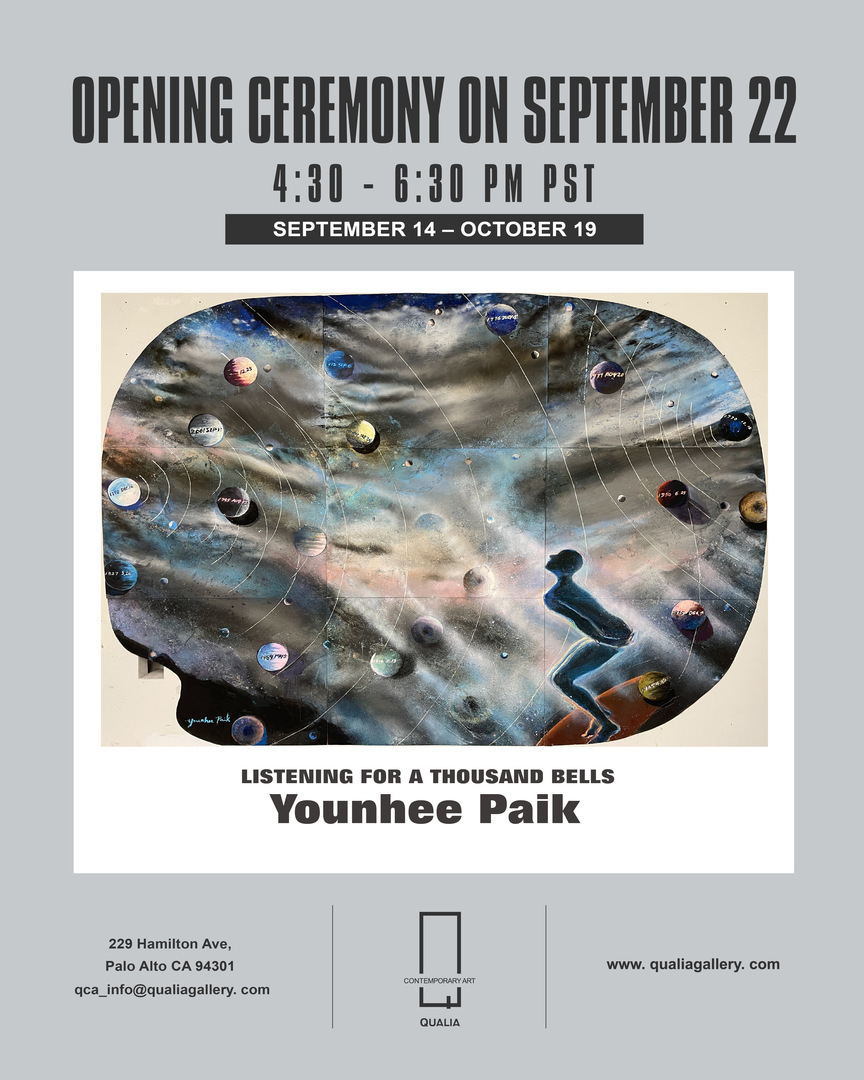
The artist’s process in the studio harnesses the sense of entropy that is so present in the natural world. Listening for a Thousand Bells, the exhibition’s eponymous work that shows a scene in outer space, was created on nine separate aluminum plates mounted on wood, coated with oil paint, and manipulated through a special technique involving poured turpentine. The orbital paths and dotted lines represent the passage of time in seconds and heartbeats as the artist searches for new adventures in the universe. The planetary shapes are created by cutting off the bottom of the plastic dishes Paik uses for mixing paints, which are coated with excess color. These shapes are then pasted as collage elements on the works. Paik emblazoned significant dates from history, as well as dates with personal meaning, upon each orb, enveloping the silhouetted figure within a chorus of voices, or “bells,” from the past.
Many of Paik’s compositions take outer space as their inspiration, with recent works grappling with the later part of her journey as an artist and a woman. Now that her children are grown, she feels like she can truly immerse herself in her work without interruption or obligations — a common experience for women who are not able to pursue their creative ambitions until later in life. Paik is drawn to celestial scenes, reminiscent of the many nights she would work in silence after her children went to bed. In the late hours, she continues to find inspiration in the expansive, unending night sky.
Listening for a Thousand Bells celebrates Paik’s expansive practice while introducing new audiences to her work in the Bay Area and beyond. The exhibition serves as an incomplete testament to Paik’s ongoing legacy within modern and contemporary art history and a touchpoint for cementing her position within the canon. As part of the gallery’s ongoing programmatic focus on contemporary Asian artists, Qualia is proud to foreground Paik as a seminal fixture of the Bay Area and Korean-American arts communities with Listening for a Thousand Bells.
