




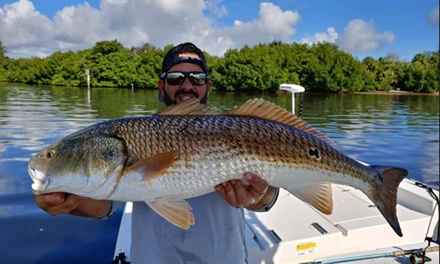
$262 for a Four-Hour Fishing Charter for Two from Pocket Change Fishing Charters LLC ($425 Value)


Appointment required, 48 hour advance notice required. Please bring refreshments, sunscreen & sunglasses. Credit card required at booking. Younger than 18 must be accompanied by guardian. Limit 1 per person. May be repurchased every 30 days. Limit 1 per visit. Valid only for option purchased. Must be 18 or older. 24-hour cancellation notice required.
Available out whatever St. Petersburg area dock is closest to the client, 24-foot boat fishes for snook, redfish, trout, snapper, and more
The Deal
- $262 for a four-hour fishing charter for two ($425 value)
- Bait, tackle, license and fish cleaning is included.
Currents: The Motion of the Ocean
Whether setting literal sail or motoring along, no boat weighs anchor without tangling with the phenomenon of currents. Check out Groupon's guide to the mysterious push and pull of the deep blue sea.
The ocean's currents function like a massive circulatory system coursing across the globe, a lifeblood responsible for heating and cooling land and replenishing sea life with nutrients. Toward the top, wind dictates the ocean’s movement, shuffling water along as it blows over the surface. These surface currents tend to flow in circular patterns, thanks to a combination of Earth’s rotation and stationary obstacles such as continents and lazy whales. Although smaller versions of these surface currents—known as gyres—can be found around the world, five main gyres comprise much of the activity on the ocean's surface, spinning in large pockets in the Atlantic, Pacific, and Indian Oceans. Because they’re mostly controlled by the wind, surface currents can vary in lifespan; some taper off after only a few months, whereas the five stalwart gyres have continually churned for thousands of years.
Deeper down, a different system of currents has also crept along for millennia. Known as the global conveyor belt, these arteries flow in one continuous loop, beginning in the cold, dense waters of the north Atlantic and snaking around the globe before returning to their start, all in a single trip lasting about 1,000 years. This slow process is largely caused by differences in temperature and density. As Arctic water gets colder and saltier, it gets denser, sinking to the bottom of the sea as warmer water rushes in to replace it, gets colder, and sinks itself—thus setting in motion the vast-reaching system that carries nutrients and regulates climates across the entire planet.
Oceans aren't the only bodies of water with currents, of course. The term can be applied to any water in motion, from the soft trickle of a stream to the collision of tributaries at the mouth of a lake. Understanding these currents helps people avoid swimming in treacherous areas, locate prime fishing spots, or ensure the safe docking and navigation of maritime vessels.
