




×
Your location has been changed to Seattle area.
This Event has Passed
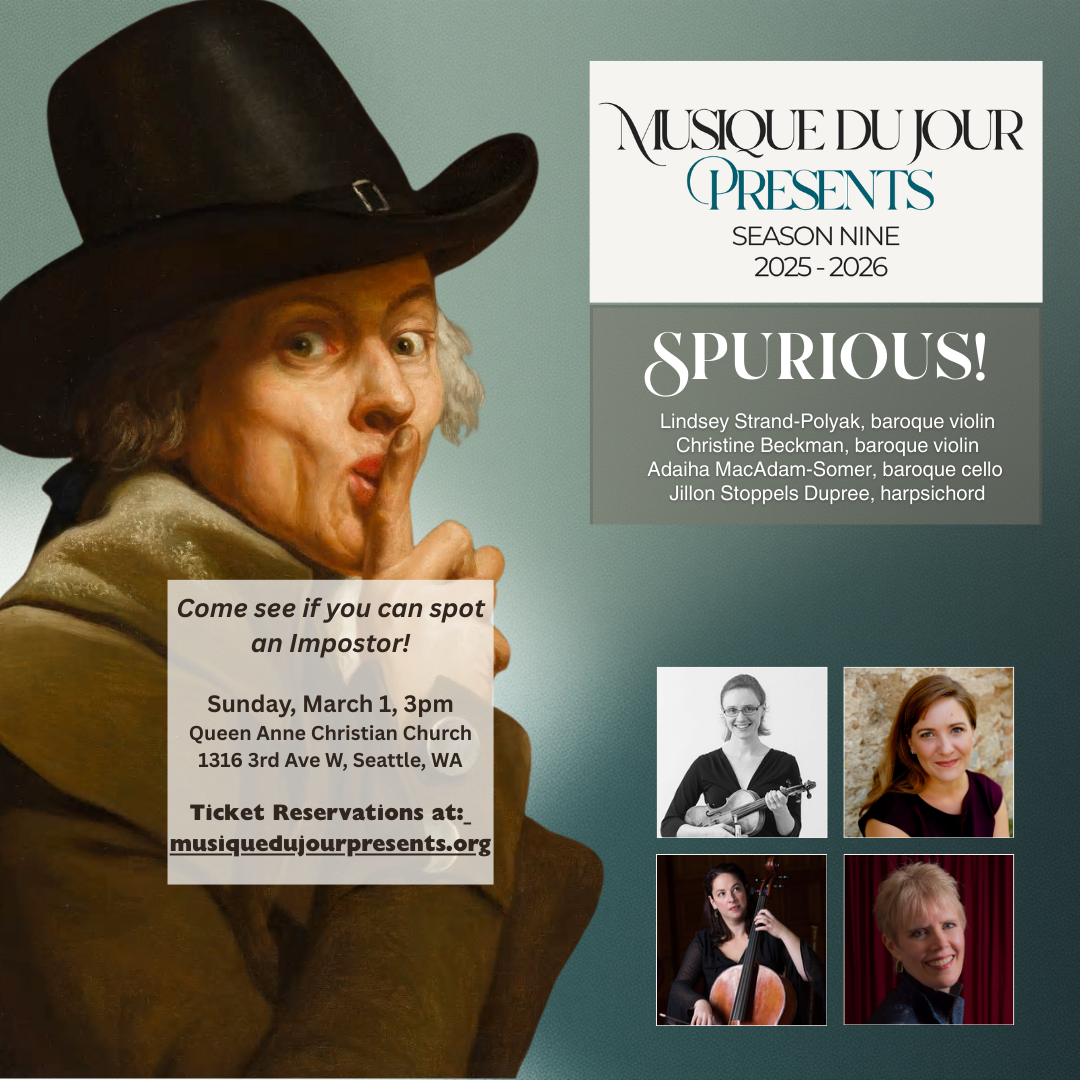
Spurious! (Early music chamber concert on March 1st at Queen Anne)


In this concert, we provocatively ask: What makes a work of art great? How much of this opinion is what you think you know, and how much is the performance itself?
When a composer’s name is written on the page, we can’t help ourselves but project what we know – or think we know– about a piece without having heard it. Sometimes, it means we assume a piece will be a guaranteed winner because of who wrote it. But will the piece be just as good if it turns out that someone else did?
There were a lot of reasons to disguise your name when publishing music. Women often had to publish under a pseudonym or a relative’s name to be better received (Emily Brontë, the author of Wuthering Heights, went by Ellis Bell, and Fanny Mendelssohn borrowed her brother Felix’s first name for publications). Sometimes, simply having an Italian name in England added to a composer’s brand, making it appear their work would be excellent because being Italian was trendy— the composer John Cooper had much better success as “Giovanni Coperario.”
And sometimes, the nom de plume worked so well, their secret died with them and their publisher... One of my favorite discoveries while putting together this program is the mysterious Mrs. Philarmonica— a 17th century composer whose true identity scholars still haven’t discovered ever since she published her two collections of chamber music in London in 1715.
But often, the reason for a misattribution is much less tantalizing than that. Composer handwriting has always been messy, copyright wasn’t always a concept, and imitation has been the sincerest form of flattery– even in baroque music. Handel has been continuously popular ever since he was alive, and many “new” compositions kept being discovered, decades after his death. Sometimes it was even more benign– styles passed between teachers and their students, or within a very musical family (ahem... the Bachs). The music keeps us guessing.
So I hope you’ll join us and play musicologist for an afternoon of Baroque music. Try to tell Bach from Bach, Corelli from Caldara, and see if you can spot an imposter!
Event Links
Tickets: https://go.evvnt.com/3495581-0
Website: https://go.evvnt.com/3495581-2
