




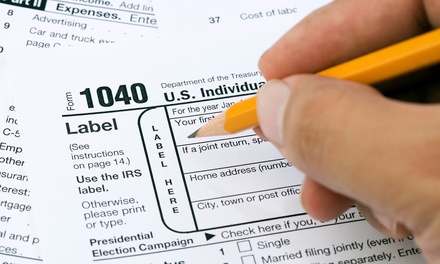
Tax Preparation Services for an Individual or Small Business from Firm1040 (Up to 45% Off)


Limit 1 per person. Valid only for option purchased. New clients only. Appointment required. 24-hr cancellation notice required.
Accounting experts streamline the process of tax preparations for individuals and small businesses, including LLCs and sole-proprietorships
Choose Between Two Options
- $82 for up to one hour of an individual tax-return preparation ($150 value)
- $206 for up to two hours of a small business tax-return preparation for an LLC or sole-proprietorship ($300 value)
The US Dollar: Currency of a Shifting World
What exactly does it mean when you earn or spend a dollar? Follow Groupon’s investigation to understand the US dollar’s global appeal.
If money makes the world go round, the US dollar is the axis around which it spins. In the years since the federal government authorized the first general circulation of paper money in 1861, the dollar has become the world’s reserve currency. It got a major boost in 1944—in the midst of World War II and following the economic tumult of the Great Depression—when 44 nations struck up an agreement known as the Bretton Woods system. These nations agreed to peg their currencies to the US dollar in order to stabilize international exchange rates.
Why the US dollar? At the time, the United States had the world’s largest and most stable economy. And the dollar was, in turn, backed by gold at an exchange rate of $35 for one ounce of bullion. By using the dollar as their standard, these 44 nations knew they’d be able to ultimately convert their currency into gold if needed.
That didn’t last. In the 1970s, President Nixon dismantled the gold standard to prevent foreign nations from claiming all the bars that reside in Fort Knox and tiling the floors of every bathroom in the White House. Even so, more than a dozen countries, including the Netherlands, Hong Kong, and Venezuela, still peg their currency to the US dollar, and its status as preeminent international currency far outstrips its nearest competitor, the Euro. According to the Wall Street Journal, in 2011 85% of foreign-exchange transactions worldwide involved American dollars.
Today, calls for a new international monetary system occasionally ring out as the United States faces increasing economic and political uncertainties. Even some parts of the United States have opted to hedge their bets by using their own local currencies—as CNN reported in 2012, groups of up to several hundred people around the country have taken advantage of the fact that it’s perfectly legal for individual communities to create new forms of money. Ranging from the BerkShares of Southern Berkshire, Massachusetts, to the Life Dollars of the Seattle area, these are often meant to keep money circulating locally. But even in these cases, law requires that they remain tied to the still-mighty US dollar.
Get this Deal