




This Event has Passed
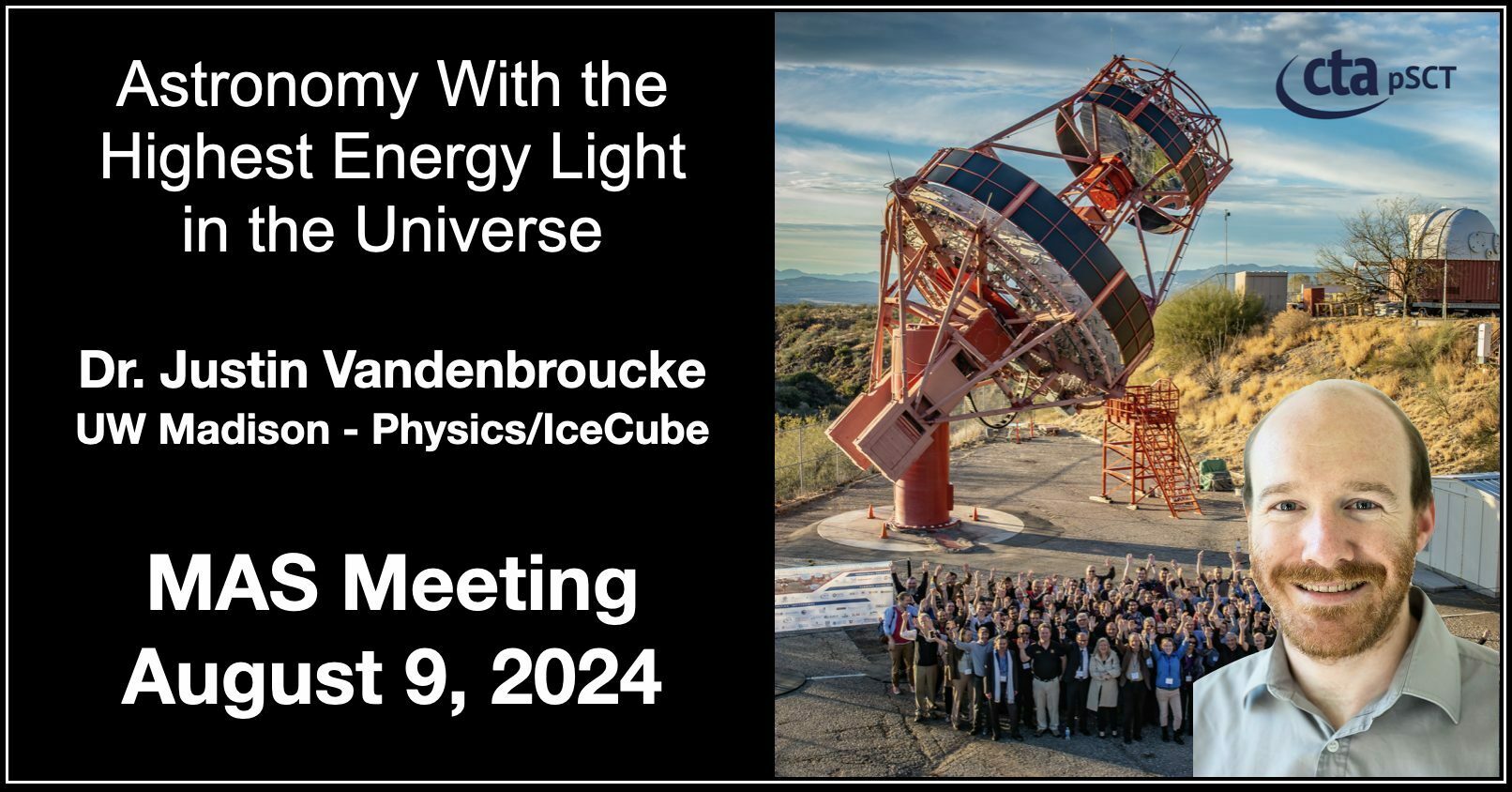
Astronomy With the Highest Energy Light in the Universe


Major breakthroughs have been made in astronomy by expanding observations to far longer and far shorter wavelengths than we can see with our eyes. The shortest-wavelength photons are gamma rays, the highest energy photons in the Universe. Some of these photons are trillions of times more energetic than the human eye can detect. There is a surprising variety of astronomical sources glowing or flashing in these very-high-energy gamma rays. They are powered by some of the most extreme objects in the Universe: exploding stars, white dwarfs, neutron stars, and black holes. I will describe the science that very-high-energy gamma rays enable and the prospects for the Cherenkov Telescope Array Observatory, an international project currently under construction.
About the speaker: Justin Vandenbroucke is an associate professor at the University of Wisconsin–Madison, in the Physics Department and Wisconsin IceCube Particle Astrophysics Center. His research focuses on gamma-ray astronomy with the Cherenkov Telescope Array Observatory, neutrino astronomy with the IceCube Neutrino Observatory, and citizen science with the Distributed Electronic Cosmic-Ray Observatory. Vandenbroucke obtained his PhD in Physics from UC-Berkeley and held postdoctoral positions as a Kavli Fellow at Stanford University and NASA Einstein Fellow at SLAC National Accelerator Laboratory. Vandenbroucke is currently a UW–Madison Vilas Associate.
Event Links
YouTube: https://go.evvnt.com/2538761-0
