




×
Your location has been changed to Houston area.
This Event has Passed
Forb bend Symphony Orchestra


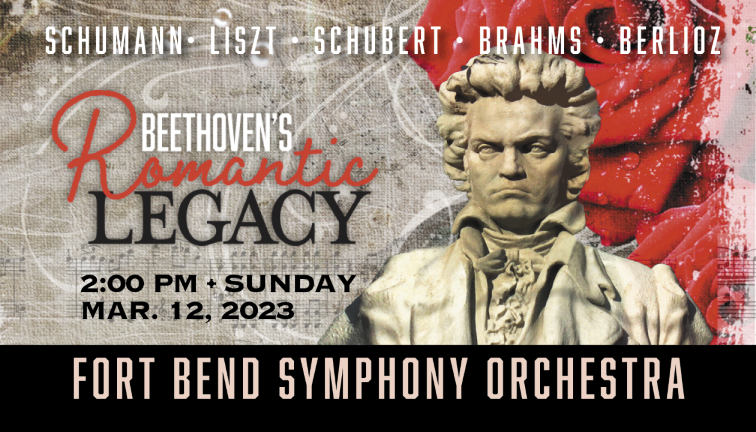
Beethoven’s Romantic Legacy Info Sheet
Beethoven was a towering genius among men. His contribution to classical music is
unparalleled, especially for his time. The composers in the generation after Beethoven all had to
wrestle with the icon that was Beethoven, and they each reflected Beethoven’s genius in
different ways. In the concert Beethoven’s Romantic Legacy, we see how each composer on the
program, famous in their own right, came to terms with the legacy that Beethoven had left
them.
Brahms once remarked to a friend, “I shall never write a symphony! You can’t have any idea
what it’s like always to hear such a giant marching behind you!” The subject of his ire was
Beethoven. At the time of that letter, Brahms was nearly 40 and Europe’s most famous
composer. Way back when Brahms was 20, Robert Schumann declared him the heir to
Beethoven in the pages of his musical journal, Neue Zeitschrift für Musik. Brahms spent the
next 20 years writing his first symphony, working under the shadow of Beethoven’s genius and
Brahms’ self-critical standards of perfection. When his first symphony was finally premiered in
1876, conductor Hans von Bülow called it “Beethoven’s tenth” due to similarities between
Beethoven's and Brahms's work. The work on this concert, Brahms’ Tragic Overture, was written
in 1880 after the premiers of his first two symphonies, in the prime of his symphonic writing.
Berlioz came late to the revelation that was Beethoven. His musical influences began in the
Opera, with Spontini and Gluck. However, when Berlioz finally heard the music of Beethoven, he
remarked, “As far as symphonies are concerned, Mozart wrote 17 of which 3 are beautiful and
even then… The good Haydn produced a quantity of pretty things of that kind. Beethoven
wrote seven masterpieces but Beethoven is not human. And when you are only a human being
you should not pass judgement on the God.” Berlioz’s writing and Beethoven's writing were
linked in the public eye for as long as Berlioz was an active composer. In a letter to Berlioz after
attending a performance of Harold in Italy, Paganini gifted him 20,000 francs and started the
letter with “Beethoven dead, only Berlioz was able to bring him back to life.” The work in the
concert is the Hungarian March from Part One of La damnation de Faust, written in 1846.
Liszt’s interactions with Beethoven start with an apocryphal story about Beethoven attending a
concert of the 11-year-old Liszt, and after being moved by an improvisation on the program,
came up and gave Liszt what is now called the “Weihekuss” or consecration kiss, shooting Liszt
to international fame. Apocryphal stories aside, Liszt was deeply moved by the music of
Beethoven. Liszt began his veneration by playing the 10 Beethoven piano sonatas in public
concerts for the first time, elevating the works to public discourse. Liszt also created
arrangements of all nine symphonies for the piano, helping their dissemination around Europe.
Liszt’s rock-star popularity helped life the lesser-known works of Beethoven out of the shadows.
The work on this program is Liszt’s Hungarian Rhapsody No. 2, orchestrated by Muller-Berghaus,
first composed in 1847.
Robert Schumann was 16 when Beethoven died. For the rest of his life, Schumann tried to
channel the essence of Beethoven in his life and work. Schumann co-founded a music journal,
the Neue Zeitschrift für Musik (New Journal for Music), in part to bring the focus back to
composers of the past, including Beethoven. Schumann also quoted Beethoven heavily in his
own music as a way to pay homage to the master. This concert contains Schumann’s Manfred
Overture, the only popular segment from Manfred, a semi-staged opera about Lord Byron’s
poem. The overture’s incessant rhythm is reminiscent of Beethoven’s 5th symphony.
Schubert and Beethoven lived in Vienna at the saem time for 31 years, the totality of Schubert’s
life. Schubert was exposed to Beethoven’s orchestral music through the excellent student
orchestra at his boarding school, Konvikt. It was there that Schubert became determined to
become a composer, even though he stated to a friend, “Secretly I still really hope to be able to
make something of myself, but who can do anything now after Beethoven?” Even though
Beethoven contributed major pressure on the young composer, Schubert didn’t directly
emulate Beethoven except for some direct quotations in homage. When Schubert published his
first substantial instrumental composition, the Variations on a French Theme for Piano Duet,
op.10 (D 624) in 1822, it was dedicated to Beethoven from his ‘worshipper and admirer Franz
Schubert’. Schubert was a pall-bearer at Beethoven’s funeral and died one year after the great
master. Schubert asked to be buried next to Beethoven, which is where he is still entombed
today. The work on the concert by Schumann is his great Unfinished Symphony, Symphony No.
8. Schubert started in 1822 but left with only two movements—though he lived for another six
years.
Event Links
Tickets: https://go.evvnt.com/1570216-0
Website: https://go.evvnt.com/1570216-2
