




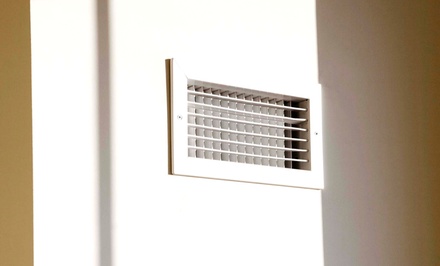
Air-Duct Cleaning from Reliable Air Duct Cleaning & Restoration Services (Up to 74% Off). Two Options Available.


Valid only within 40 miles of zip code 77008. Appointment required, same day appointments accepted. Valid for supply vents for a single unit. Valid for air-duct and dryer-vent cleaning and deodorizer. Additional fee will apply for dryer vents that are through the roof or for deep scrub brushing. Merchant's standard 24-hour cancellation/rescheduling policy applies (any fees not to exceed voucher price). Limit 1 per person, may buy 1 additional as gift(s). May be repurchased every 30 days. Limit 1 per visit. Limit 1 per household. Valid only for option purchased. All goods or services must be used by the same person.
After a thorough inspection, Insured techs clear grime and contaminants from air ducts and dryer vents
Choose Between Two Options
$109 for air-duct cleaning ($420 value)
- Deodorizer
- Main-unit inspection
- Unlimited vents for single unit
$175 for air-duct and dryer-vent cleaning ($620 value)
- Deodorizer
- Main-unit inspection
- Unlimited vents
- Dryer-vent cleaning
The Composition of Dust: Of Mites and Mars
When the cleaners are finished, you’ll be able to breathe easier. Increase your satisfaction with a look at one thing they’ve banished: dust.
Whether you’re resting in a mountain cabin, traveling through a city, or being vented out an airlock into outer space, dust is all around you. Microscopic particles—usually a combination of soil, pollen, skin cells, and minerals—can pile up quickly indoors. The problem is exacerbated by tiny creatures called dust mites, which gather in groups of up to 500 per gram of dust to devour flakes of human skin while multiplying in number, excreting waste, and probably chittering away. No matter where you are on Earth, a mote of dust is presently traveling straight toward your eye, thanks to the persistent creation of dust in almost any climate humans inhabit.
Even beyond our planet, dust is ubiquitous: astronomers face the universe’s untidiness every time they peer through a telescope and find formations of cosmic dust, which absorb the visible light around them. Although it comes from exploding stars rather than flaky humans, space dust isn’t so different from the domestic variety: a 2007 paper published in IEEE Transactions on Plasma Science explored the similarities between the formation of dust bunnies under beds and the coagulation of space dust into planets.
Get this Deal