



This Event has Passed
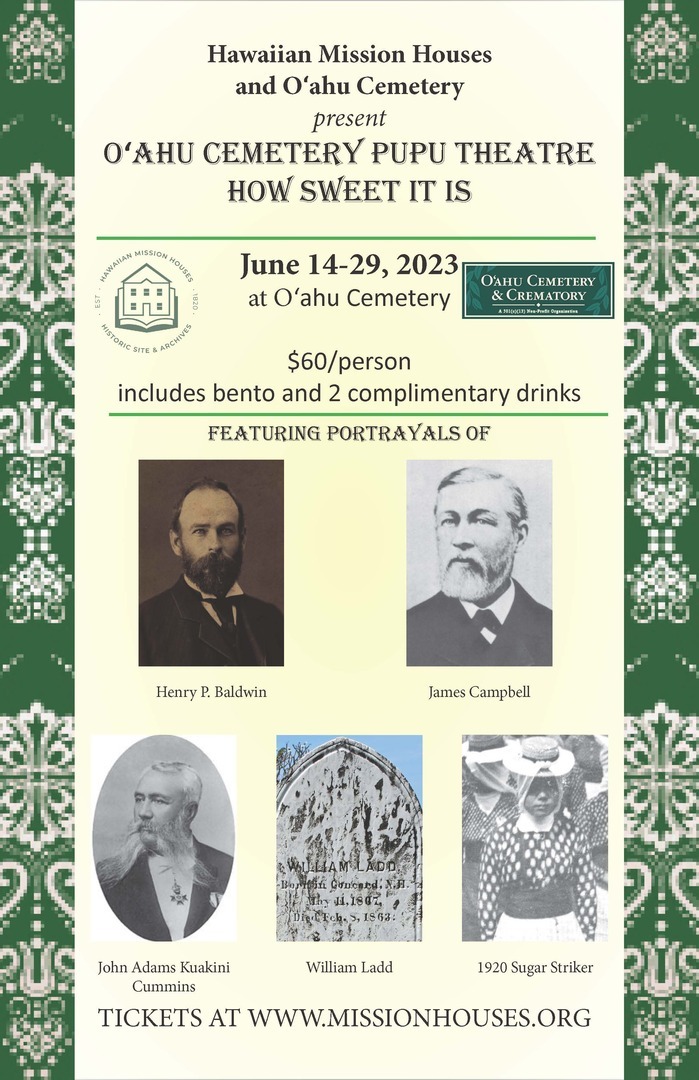
Oahu Cemetery Pupu Theatre: How Sweet It Is

Friday, June 14, 2024 - 5:00 PM
to Saturday, June 29, 2024 - 9:00 PM

5:00 PM - 9:00 PM See all dates and Times


Hawaiian Mission Houses Historic Site and Archives and cosponsor Oʻahu Cemetery Association will debut a new production of Cemetery Pupu Theatre June 14,15, 21, 22, 28, and 29, 2024 at Oʻahu Cemetery, 2162 Nuʻuanu Avenue, Honolulu, HI 96817. Tickets are $60 per person and are available at www.missionhouses.org. Ticket purchase includes two drink tickets and a heavy pupu bento. Drinks and pupu begin at 5 p.m. at the cemetery chapel, and performances begin promptly at 6 p.m.
Hawaiian Mission Houses brings history to life with carefully researched and scripted actor portrayals
of figures from Hawaiʻi’s history.
“Cemetery Pupu Theatre: How Sweet It Is” will feature five portrayals focused on the history of the sugar industry in 19th- and early 20th-century Hawaiʻi. Featured portrayals this year are:
James Campbell (1826-1900) Born in Londonderry, Ireland, Campbell took a ship to Canada at age 13, met with his brother John in New York City, and worked as a carpenter. In 1841, he joined a whaling crew and was shipwrecked in the Tuamotu Islands. Making his way to Tahiti, he lived there for several years before travelling to Lahaina, Maui in 1850. In 1860, in partnership with Henry Turton and James Dunbar, he founded Pioneer Mill Company in Lahaina and in 1863, the company bought the Lahaina Sugar Plantation. The company was profitable and Campbell used his proceeds to purchase land on Hawaiʻi Island and Oʻahu. He sunk the first artesian wells on the ʿEwa Plain, which opened up Leeward Oʻahu to more expansive sugar plantation operations. He also owned ranches at Honouliuli and Kahuku on Oʻahu, becoming one of the largest landowners and wealthiest people in Hawaiʻi.
Henry Perrin Baldwin (1842-1911) Born in Lahaina to missionary parents Rev. Dwight Baldwin and Charlotte Fowler Baldwin, he attended Punahou School on Oʻahu before returning to Maui to become a farmer. His first plantation manager job was for William D. Alexander’s rice plantation. The plantation
failed and he went to work for his brother’s small sugar cane farm. He worked as a luna at the Waiheʻe Planation, managed by his future business partner Samuel T. Alexander. In 1869 they began planting in Hāmākuapoko on Maui. With reciprocity, the sugar industry grew quickly and he oversaw the construction of the Hāmākua Ditch irrigation system. He oversaw the building of several mills on Maui such as the Hāmākuapoko Mill, the Haʿikū Mill, and Pāʻia Mill. In 1888, he helped to form the Haleakalā Ranch. Alexander and Baldwin was officially incorporated in 1900 and is still an ongoing business today.
John Adams Kuakini Cummins (1835-1913) Born in Honolulu to Thomas Jefferson Cummins, Jr. and High Chiefess Kaumakaokane Papaliʻaiʻaina. His father owned much of the land in Waimānalo, Oʻahu and began ranching there in the 1840s. John Adams Kuakini Cummins converted the ranch to a
sugar plantation in 1877 and built a sugar mill there, forming and becoming president of the Waimānalo Sugar Company. He was noted for his lavish entertainment of royalty at Mauna Loke, his home. He served in the Hawaiian Kingdom legislature and in the cabinet of King Kalākaua. He was involved with the 1895 counter-revolution to restore the Hawaiian monarchy.
William Ladd (1807-1863) Born in Concord, New Hampshire, to John Ladd, a sailor who died at sea while William was young. He married Lucretia Goodale, a relative of Lucy Thurston, a missionary to Hawaiʻi. He sailed to Hawaiʻi with his friends and business partners William Hooper and Peter
Brinsmade, arriving in 1833 aboard the Hellespont. They incorporated as Ladd & Company in 1833 and opened up a dry goods store at Honolulu Harbor. In 1835, the company leased over 900 acres from the government at Kōloa, Kauaʻi to plant sugar cane. Kōloa Plantation was the first attempt at a
commercial sugar cane plantation in Hawaiʻi. Initially the plantation did well, but the business partners took on more and more debt to finance improvements to their sugar mill and to obtain more land. Attempting to shore up their finances Brinsmade went to Europe and struck a deal with the Belgian
Colonization Company which fell through after the Paulet Affair of 1843. Ladd & Company closed its store in Honolulu in 1844.
Striking sugar worker from the 1920 plantation strike – The 1920 Sugar Strike was the first multiethnic strike in Hawaiʻi’s sugar industry. Previous strikes like the 1904 and 1909 strikes were led by workers of a single ethnic group. Typically the plantation managers would pit one ethnic group against
another to break the strike. In 1920 Filipino plantation workers began the strike and were joined by the Japanese Federation of Labor. The strike lasted six months before changes were made to the wages and living conditions of plantation workers in Hawaiʻi.
For more information or ticket purchases, please visit www.missionhouses.org
# #
Event Links
Tickets: https://go.evvnt.com/2443334-0
