




×
Your location has been changed to Detroit area.
This Event has Passed
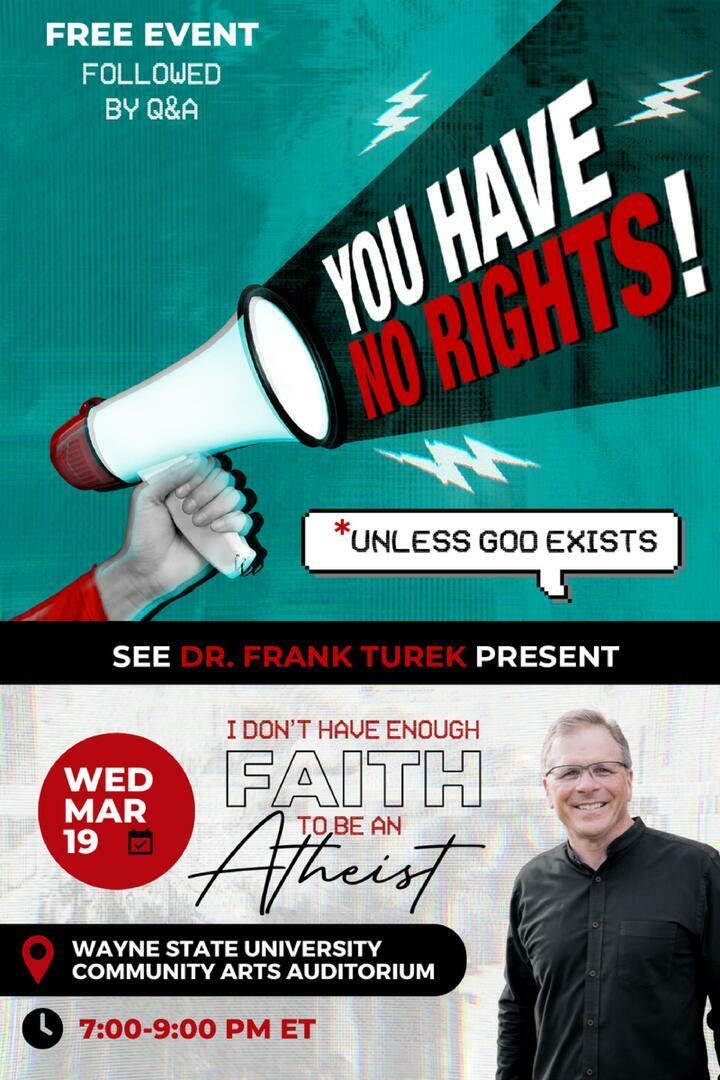
Lecture: "I don't have enough Faith to be an Atheist!" Dr. Frank Turek


I Don’t Have Enough Faith to Be an Atheist tries to answer a simple question: Are the claims of the Bible reasonable enough to be believed? Geisler and Turek set out to prove that Christianity is far more reasonable than any other belief system, including atheism. Backed by mountains of biblical and non-biblical evidence, Geisler and Turek set out to prove that “it takes a lot more faith to be a non-Christian than it does to be a Christian” .
I Don’t Have Enough Faith to Be an Atheist follows a twelve-step outline to prove that Christianity is the most reasonable belief system. Starting at the point of complete skepticism, their outline begins with two ideas. First, truth about reality is knowable. Second, the opposite of true is false. These two statements are meant to engage people who have thoughts such as, “All truths are relative.” Geisler and Turek encourage the use of the Road Runner tactic (39ff), which helps expose such statements as self-defeating. For example, take the statement, “There is no such thing as truth.” Is that statement true? If so, then there is such a thing as truth. They also use the Law of Noncontradiction (56ff) to show that because truth exists, the opposite of true must be false.
Point number 3 of Geisler and Turek’s twelve-step process states, “It is true that the theistic God exists. This is evidenced by the beginning of the universe, design of the universe, design of life, and the moral law” (71). The four chapters covering this point are heavy on science, but provide fascinating insights into speaking with evolutionists and non-Christians. For example, Geisler and Turek show how the Big Bang Theory is stronger evidence for creationism than evolution. They say, “Everything that had a beginning had a cause. The universe had a beginning. Therefore the universe has a cause” (75). While evolutionists claim that this first cause was random chance or a spontaneous “something out of nothing” moment, the far more reasonable conclusion is that the first cause was a powerful being who created the universe (aka God).
Points 4 and 5 of Geisler and Turek’s twelve-step outline continue, “If God exists, then miracles are possible. Miracles can be used to confirm a message from God” (195). The logic of these two points is summed up on page 209: “If there is a God who can act, there can be acts of God (miracles).” Geisler and Turek contend that God uses miracles to confirm the revelation of his Word (209).
Point 6 states, “The New Testament is historically reliable. This is evidenced by early testimony, eyewitness testimony, uninvented (authentic) testimony, and eyewitnesses who were not deceived” (219). The four chapters covering these points will be a more familiar topic for pastors, as they dovetail with the same textual criticism principles learned during college and seminary classes. This section culminates with a massive amount of evidence that proves beyond a reasonable doubt that Jesus rose from the dead (299-319).
Points 7 through 12 pick up the pace as they follow a simple logical progression. “The New Testament says Jesus claimed to be God. Jesus’ claim to be God was miraculously confirmed by his fulfillment of many prophecies about himself, his sinless life and miraculous deeds, and his prediction and accomplishment of his resurrection. Therefore, Jesus is God. Whatever Jesus (who is God) teaches is true. Jesus taught that the Bible is the Word of God. Therefore, it is true that the Bible is the Word of God (and anything opposed to it is false)” (325). Scientific observations and logical deductions from those observations formed the basis of the first six points, but these final six points lean more heavily on Scripture. Through the use of Scripture, logic, deduction, and extra-biblical evidence, Geisler and Turek arrive at their final destination: the Bible is the Word of God, and any reasonable person would believe that.
All told, I Don’t Have Enough Faith to Be an Atheist accomplishes its goal. It starts at the most skeptical of starting points and proves beyond a reasonable doubt that the Bible is God’s Word and should be believed. Geisler and Turek lay out their argument in a logical, thought-provoking, and easy-to-read manner.
In a world that is increasingly godless and closed off to Scripture, I Don’t Have Enough Faith to Be an Atheist will help equip Christians of all kinds as they prepare to share their faith and bring light to a darkened world.
Event Links
Website: https://go.evvnt.com/2935548-0
